Event description
For three days in April the Pennsylvania Society of Physics students hosted an art exhibition motivated by the concept that the scientific and artistic communities should talk and learn from one another. Lasers are a wonderful way to start this communication between disciplines; lasers are ubiquitous in society yet often poorly understood by the general public.
All students, faculty, and members of the local public were encouraged to submit artistic works in various media. The only condition was that their work should portray an understanding of the science and importance of lasers, as detailed in an accompanying essay. In order to encourage participation and quality, cash prizes were awarded.
University students were the most eager group. We received twelve diverse displays from students of a wide variety of backgrounds, including economics, astronomy, visual arts, and painting. These works were designed to highlight both the scientific and aesthetic aspects of lasers. Two faculty judges, one each from the Eberly College of Science and the College of Liberal Arts, judged the pieces to determine the allocation of prizes.
The exhibition itself was publicized on campus and began with a reception where artists and visitors mingled and discussed the works over refreshments. Thereafter, the display remained open in the Verne M. Willaman Gatway to the sciences, the main walkway between Penn State’s life science and chemistry buildings, for two days. After this, the works were moved to the Penn State Learning Center where they remained on display for remainder of the semester.
Impact
Attendees of the reception and later viewers of the exhibition were exposed to the history, science, and applications of lasers with a poster and table display throughout the event. The display explained how lasers tied into the theme of the exhibition. This poster also included acknowledgement of the Laserfest grant.
The event itself included the work of five student volenteers and 2 faculty judges. 25 people total participated in the initial event and an unknown number saw the artwork and LaserFest poster during the time the exhibit was displayed in the walkway and in the Penn State Learning Center. The group was quite diverse. About 70% of the entries were from women one of the faculty judges was African American, and two participants that had entries even though they were studying abroad at the time.
Feedback and Publicity
After the event we received feedback from student organizers, faculty judges and members of the Penn State Exhibition Club about the event. Specifically, we discussed the effectiveness of the venue and organization as it pertained to reaching an audience beyond the scientific community. SPS will be partnering with the Exhibition Club for a similar event in 2011.
Our chapter was featured in the Winter 2009 edition of the SPS Observer on page five. The web version of this can be found here:
http://www.spsobserver.org/2009/observer_winter.htm
Final Budget
Facilities: $150
Advertising and Prizes: $340
Materials for the laser display: $60
Food for reception $100
Total: $650
Showing posts with label LaserFest on the Road. Show all posts
LaserFest at William and Mary
Principle coordinator and organizer: Irina Novikova
Student core group: Ron Wilcox, Francesca Fornacini (Sprint’10), Patric King (Fall’10), Tim Melburn (Fall’10), Anne Mennen (Fall’10).
Participating faculties: Seth Aubin, Eugeniy Mikhailov,Hannes Schniepp
We also worked in close collaboration with WM OSA student chapter (president – Matt Simons)
Information about all the event is available here: http://physics.wm.edu/laserfest/
Activities:
1. Campus-wide photo contest (March-April 2010)
All members of College of William and Mary community were welcome to submit laser-related photos.
Event details can be found here: http://physics.wm.edu/laserfest/LaserFestPhotocontestatWM/
Number of organizers: 4
Number of participants: 20 (not everyone submitted photos at the end)
2. LaserFest Open House at Physics Department (November 11, 2010)
Physics department of William and Mary opened doors for general audience.
Information about the event can be found here: http://physics.wm.edu/laserfest/OpenHouse.htm
Photo contest first place: Daniel Eicher
The list of activities:
a) Research lab visits.
Participating scientists:
Seth Aubin – Laser Cooling and Ultra-cold Matter;
Gunter Luepke – Ultrafast Material Studies;
Irina Novikova and Eugeniy Mikhailov – Quantum and Nonlinear optics;
Bill Cooke – Biophysics
Todd Averett – Experiments with Subatomic Particles
For our younger visitors we offer an exciting treasure hunt, in which they had to visit all the laboratories and ask specific questions to get a prize!
b) Interactive laser demonstrations
We have presented demonstrations from our LaserFest Road Show (HeNe laser operation, Mechanical action of the laser on Balloons, Liquid Fiber Optics), plus an experimental demonstration on particle/wave duality.
c) Laser-inspired photo contest
We provided simple keychain lasers for people to explore lasers and take photos. This was a very popular activity, but nobody sent us photos afterward.
Photo contest second place: Travis Horrom
d) “Amazing Lasers” presentations from William&Mary professors
Speakers
Prof. Seth Aubin “Laser cooling and Atom Lasers”
Prof. R. Ale Lukaszew “Blue-Ray DVD technology”
Prof. Hannes C. Schniepp “Atomic Force Microscopy: Sub-Nanometer Precision Guided by Laser Light”
Prof. Irina Novikova “Quantum Internet”
Prof. Bill Cooke “Visualizing cancer molecule by molecule: Laser Desorption Mass Spectroscopy”
Prof. Eugeniy Mikhailov, “LIGO: Laser Detection of Ripples in Space”
e) OSA student chapter has organized “Hit the target competition”
Number of organizers: around 20
Number of visitors: around 200 from Williamsburg and greater Hampton Road area.
News coverage of this event:
Photo contest third place: Peter Ross
3) LaserFest Road Show demonstrations
We visited several local schools (plus we organize a show for students visiting from Georgia).
More information about our demonstrations is available here: http://physics.wm.edu/laserfest/lasershow_web.htm
School visited
a) Nov. 2 New Horizon Educational Center, Hampton VA
Number of attending students: 15
Video recording is available here: http://nhgs.tec.va.us/~Elena.Kuchina/LaserShow.MPG
b) Nov. 3 Yorktown Elementary School, Yorktown VA
Number of attending students: 50
c) Nov. 23 Berkeley Middle School, Williamsburg, VA
Number of attending students: 220
Photographs are available here: http://physics.wm.edu/laserfest/LaserFestroadshowvisitsBerkeleyMiddleSchool/index.html
d) Nov. 29 Jamestown High School, Williamsburg, VA
Number of attending students: 75
e) Dec. 4 We had visitors from 5th grade class from Brookwood School in Thomasville, Georgia
Number of attending students: 30
We also have two more event scheduled in Yorktown Elementary School in February-March for more class visits and PTA science night (Feb. 15).
Photo contest third place: Jeffrey Nelson
Our demonstrations are available on-line on youtube.com. These are recently updated videos (to improve quality of presentation)
Total internal reflections and liquid fiber optics
Basics of Laser operation and Helium Neon laser
http://www.youtube.com/watch?v=oJUja0Fq2-8
Balloon popping and mechanical action of the laser (great for teaching laser safety too!)
http://www.youtube.com/watch?v=gVwdF1RcYv0
Balloon in the balloon and basic properties of laser light
http://www.youtube.com/watch?v=HQSoalJHq8k
Beam Me Up Scottie! at Agnes Scott College
Report by Amy Sullivan
Agnes Scott College’s Beam Me Up Scottie! Event on October 8, 2010 was a big success! We had over one hundred members of the community, including students, staff, and local residents. The event consisted of three rooms of laser demonstrations, one for Lasers in the Movies, one for Lidar, and one large room for the Laser Telephone, Hands on Optics, and Laser Spectroscopy/Guidestar demonstrations. In addition to these events, visitors had the opportunity to attend a planetarium show and view the sky through the college’s telescope. There were student and faculty volunteers from Agnes Scott at each of the demonstrations to help visitors. Pictures of the demonstrations can be found at
http://picasaweb.google.com/amy.c.sullivan/Laserfest?authkey=Gv1sRgCJ7avc6hqeO8IQ#.
A website has been set up to advertise the event as well as to provide an educational site containing information on lasers and their applications. This can be found at http://ecademy.agnesscott.edu/~asullivan. The site has been linked to the Physics & Astronomy Department website at Agnes Scott and is listed in the information for the event on the Laserfest website. In addition to general background information, the website contains information, pictures, and/or videos on each module that we built. There are five short videos, filmed by students at Agnes Scott, which describe our Lidar system, our hands-on-optics demonstrations, our Lasers in the Movies demonstrations, laser spectroscopy, and our laser telephone. These videos are available on the front page of our Laserfest website and are also linked from our Department of Physics & Astronomy website. This report contains more details each of the demonstrations at our Laserfest event.
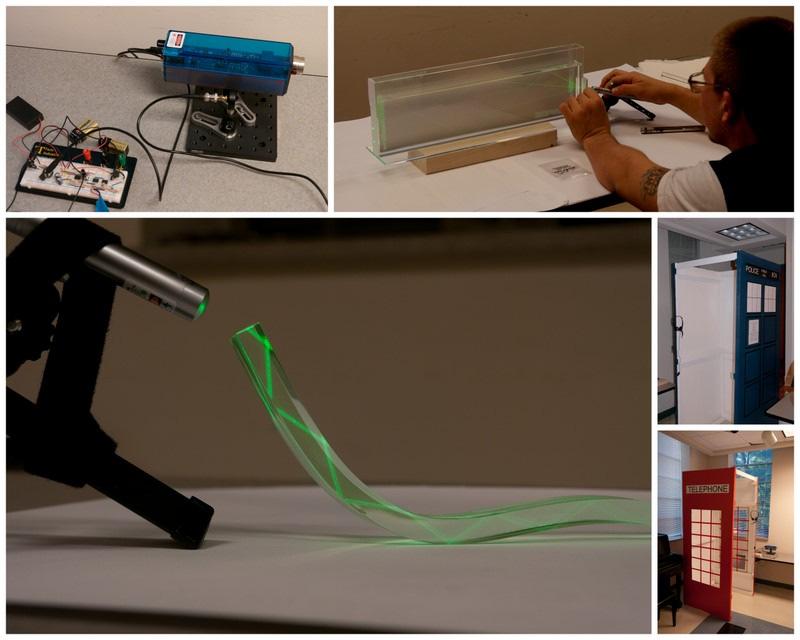
Our laser communications demonstrations were very popular with visitors of all ages. The demonstration included a laser telephone, two hands-on demonstrations of total internal reflection, and a fiber patch cord. The telephone consisted of two telephone booths, one designed as a British telephone booth, and the other modeled after the Tardis from the television show “Dr. Who.” Each booth had a computer headset that visitors could use to talk to one another across the room. The signal went to a circuit built in-house to amplify and then send the signal to a modulatable red diode laser. The laser traveled through free space to the other side of the room, where it was detected by a photodetector and sent through another circuit to clean up and amplify the signal before entering the second headset. Visitors could talk to each other through the headsets and could block the laser beam with their hands to see that the sound was coming through the laser beam. In between these booths was some printed information on optical communications along with a large plastic optical waveguide and small fish tank with laser pointers to demonstrate total internal reflection. A standard fiber patch cord was included for visitors to see what a real optical fiber looks like. Pictures of these demonstrations are shown in Figure 1 above.
The laser spectroscopy and laser guidestar demonstration consisted of a hydrogen lamp and hand-held spectrometers along with a Doppler-free spectroscopy of Rubidium experiment (Figure 2). The lamp and spectrometers allowed visitors to get a feel for how light is made up of many colors before they came by the Rb experiment. This experiment consisted of a tunable diode laser that is tuned to the Rb resonance, an Rb cell, and an IR camera. The laser had an open top so that visitors could see inside and the wavelength could be adjusted by hand to demonstrate the workings of the laser to the participants. The laser was tuned on and off the Rb resonance, showing how the atoms glow when hit with the appropriate wavelength of light. Printed information and a volunteer explained this process to visitors and showed how this experiment could be used to learn more about Rb atoms and also how laser guidestars work in astronomy.
The hands-on-optics demonstrations were the most interactive and some of the most popular demonstrations at our Laserfest event (Figure 3). The demonstrations included a white light source that had color filters on one end for visitors to explore how light colors add, and a multiple slit on the other end to produce three rays that could be used to explore how light travels through lenses, reflects off of mirrors, and reflects and refracts at surfaces. There was also a laser ray box with a separate set of optical elements, such as lenses, an adjustable curved mirror, glass plates, and prisms that could also be used to explore light propagation. Visitors of all ages had fun trying different components and combinations of components. There was also a laser maze (the white box shown above) with a HeNe laser input and a series of mirrors (and a beamsplitter) that could be rotated to steer the beam around inside the box. There were four targets of increasing difficulty for visitors to practice their skills at aligning light beams. All of our visitors enjoyed the challenge of this game.
Another popular set of demonstrations was our Lasers in the Movies room (Figure 4). This room had three demonstrations. There was a display set up with information on how DVD and Blu-ray players work along with a 405 nm laser pointer to demonstrate the color of the Blu-ray laser. Visitors could see both the color of the laser on a regular background and explore fluorescence by pointing the laser at a white piece of paper. We also had a laser espionage demonstration. For clarity of the demonstration, especially in a loud and busy room, we used a Michelson interferometer with a window in one arm. We had a speaker that could be turned on and off, or visitors could talk near the window and see how the interference pattern changed. A student volunteer explained how this could be used to record audio signals from the interference pattern. Finally, we had a laser security system set up with both red and green lasers with movie clips playing in the background from popular movies that show laser security systems. Our volunteer demonstrated how the system looked normally, when the visitors could not see the lasers and could not successfully navigate the laser security system. Then we used fog in a can and chalk dust to show the laser beams and challenged the visitors to try to make it through the lasers without breaking the beam path. This was especially popular with our younger crowd.
Our final room at the Beam Me Up Scottie! event housed Agnes Scott’s laser radar system (Figure 5). This instrument is supported by an NSF CCLI grant and internal Agnes Scott funding, which allowed us to collect a large amount of data on the atmosphere above Decatur, Georgia over the summer. A summary of the data collected can be found at http://earlobservations.weebly.com, which is also linked to our Beam Me Up Scottie! website. We had two volunteers, one faculty member and one student, who demonstrated how the instrument works and explained to visitors what properties of the atmosphere we can measure. We had posters on the wall showing the details of the operation of the laser radar system and summaries of some of the summer data. Fortunately, the weather cooperated, and visitors could watch the instrument collect data and view the green laser beam (Figure 5) shooting out into the clear night sky.
Though our Laserfest event is over, we are continuing our focus on lasers in the physics and astronomy department at Agnes Scott. Our students set up a nice display in the physics wing of our science building that describes lasers and their applications. The display includes a DVD and Blu-ray player and information that discusses how they are different. There is also a fiber optic patch cable and a fiber magnifier with information on fibers and optical communications. Finally, there is a clear HeNe laser so visitors can see into the laser and find information on how lasers work. A picture of the display is shown in Figure 6.
In addition to on-campus activities, we have offered activities developed for Laserfest to local schools interested in physics and physical sciences field trips. We are in conversations with teachers and science club mentors at the middle school and high school in our local public school system to schedule Laserfest field trips during class and for after-school enrichment during the spring term 2011. We have also just recently begun talking with a Cub Scout leader about the possibility of doing a version of the demonstrations that would be appropriate for a younger crowd. We are excited to have these demonstrations to be able to share our enthusiasm and knowledge of lasers with our local community and students and generating more interest in optics.
The Beam Me Up Scottie! outreach event was a big success and the demonstrations that we developed with the Laserfest funds will allow us to continue our outreach both on- and off-campus in the future. Both building the demonstrations and the event itself generated a great deal of enthusiasm among our students for lasers and laser related research. The projects allowed many of our students to get hands-on experience with building demonstrations and explaining their work to our local community as well. This was a great opportunity for us at Agnes Scott, and we are excited to have been able to be a part of the larger Laserfest celebration.
Acknowledgements
The work on Beam Me Up Scottie! would not have been possible without the help of many people at Agnes Scott College. I would like to acknowledge our faculty members, Art Bowling and Chris De Pree, who not only consulted from time to time on planning for the event, but both worked as volunteers during our Laserfest event. Two of our students, Mary Hinkle and Sophia Newton, planned, filmed and edited all the videos that are up on our website now. They also did much of the construction of our demonstrations. Other students, Ethan Sudan, Hannah Marlowe, and Melissa Meister also worked in the early stages of designing and building several of our demonstrations. The Lidar instrument that was highlighted as part of Beam Me Up Scottie! was funded by NSF grant #6026975 and the laser spectroscopy of Rb experiment was made possible by a generous donation of equipment from Bates College.
Agnes Scott College’s Beam Me Up Scottie! Event on October 8, 2010 was a big success! We had over one hundred members of the community, including students, staff, and local residents. The event consisted of three rooms of laser demonstrations, one for Lasers in the Movies, one for Lidar, and one large room for the Laser Telephone, Hands on Optics, and Laser Spectroscopy/Guidestar demonstrations. In addition to these events, visitors had the opportunity to attend a planetarium show and view the sky through the college’s telescope. There were student and faculty volunteers from Agnes Scott at each of the demonstrations to help visitors. Pictures of the demonstrations can be found at
http://picasaweb.google.com/amy.c.sullivan/Laserfest?authkey=Gv1sRgCJ7avc6hqeO8IQ#.
A website has been set up to advertise the event as well as to provide an educational site containing information on lasers and their applications. This can be found at http://ecademy.agnesscott.edu/~asullivan. The site has been linked to the Physics & Astronomy Department website at Agnes Scott and is listed in the information for the event on the Laserfest website. In addition to general background information, the website contains information, pictures, and/or videos on each module that we built. There are five short videos, filmed by students at Agnes Scott, which describe our Lidar system, our hands-on-optics demonstrations, our Lasers in the Movies demonstrations, laser spectroscopy, and our laser telephone. These videos are available on the front page of our Laserfest website and are also linked from our Department of Physics & Astronomy website. This report contains more details each of the demonstrations at our Laserfest event.
Figure 1. Clockwise from upper left: laser telephone laser
and circuit, fish tank demonstrating total internal
reflection, Tardis, British phone booth, large plastic
waveguide.
and circuit, fish tank demonstrating total internal
reflection, Tardis, British phone booth, large plastic
waveguide.
Our laser communications demonstrations were very popular with visitors of all ages. The demonstration included a laser telephone, two hands-on demonstrations of total internal reflection, and a fiber patch cord. The telephone consisted of two telephone booths, one designed as a British telephone booth, and the other modeled after the Tardis from the television show “Dr. Who.” Each booth had a computer headset that visitors could use to talk to one another across the room. The signal went to a circuit built in-house to amplify and then send the signal to a modulatable red diode laser. The laser traveled through free space to the other side of the room, where it was detected by a photodetector and sent through another circuit to clean up and amplify the signal before entering the second headset. Visitors could talk to each other through the headsets and could block the laser beam with their hands to see that the sound was coming through the laser beam. In between these booths was some printed information on optical communications along with a large plastic optical waveguide and small fish tank with laser pointers to demonstrate total internal reflection. A standard fiber patch cord was included for visitors to see what a real optical fiber looks like. Pictures of these demonstrations are shown in Figure 1 above.
Figure 2. Clockwise from upper left: full spectroscopy
system, close up of diode laser, hydrogen lamp,
spectrum of room lights through hand-held
spectrometer.
system, close up of diode laser, hydrogen lamp,
spectrum of room lights through hand-held
spectrometer.
The laser spectroscopy and laser guidestar demonstration consisted of a hydrogen lamp and hand-held spectrometers along with a Doppler-free spectroscopy of Rubidium experiment (Figure 2). The lamp and spectrometers allowed visitors to get a feel for how light is made up of many colors before they came by the Rb experiment. This experiment consisted of a tunable diode laser that is tuned to the Rb resonance, an Rb cell, and an IR camera. The laser had an open top so that visitors could see inside and the wavelength could be adjusted by hand to demonstrate the workings of the laser to the participants. The laser was tuned on and off the Rb resonance, showing how the atoms glow when hit with the appropriate wavelength of light. Printed information and a volunteer explained this process to visitors and showed how this experiment could be used to learn more about Rb atoms and also how laser guidestars work in astronomy.
Figure 3. Clockwise from upper left: white light rays
through a single lens, laser rays through multiple
lenses, white light rays through a rectangular plastic
block, laser rays showing total internal reflection in a
prism, laser maze.
through a single lens, laser rays through multiple
lenses, white light rays through a rectangular plastic
block, laser rays showing total internal reflection in a
prism, laser maze.
The hands-on-optics demonstrations were the most interactive and some of the most popular demonstrations at our Laserfest event (Figure 3). The demonstrations included a white light source that had color filters on one end for visitors to explore how light colors add, and a multiple slit on the other end to produce three rays that could be used to explore how light travels through lenses, reflects off of mirrors, and reflects and refracts at surfaces. There was also a laser ray box with a separate set of optical elements, such as lenses, an adjustable curved mirror, glass plates, and prisms that could also be used to explore light propagation. Visitors of all ages had fun trying different components and combinations of components. There was also a laser maze (the white box shown above) with a HeNe laser input and a series of mirrors (and a beamsplitter) that could be rotated to steer the beam around inside the box. There were four targets of increasing difficulty for visitors to practice their skills at aligning light beams. All of our visitors enjoyed the challenge of this game.
Figure 4. Clockwise from right: laser security system,
Michelson interferometer, Blu-ray player.
Another popular set of demonstrations was our Lasers in the Movies room (Figure 4). This room had three demonstrations. There was a display set up with information on how DVD and Blu-ray players work along with a 405 nm laser pointer to demonstrate the color of the Blu-ray laser. Visitors could see both the color of the laser on a regular background and explore fluorescence by pointing the laser at a white piece of paper. We also had a laser espionage demonstration. For clarity of the demonstration, especially in a loud and busy room, we used a Michelson interferometer with a window in one arm. We had a speaker that could be turned on and off, or visitors could talk near the window and see how the interference pattern changed. A student volunteer explained how this could be used to record audio signals from the interference pattern. Finally, we had a laser security system set up with both red and green lasers with movie clips playing in the background from popular movies that show laser security systems. Our volunteer demonstrated how the system looked normally, when the visitors could not see the lasers and could not successfully navigate the laser security system. Then we used fog in a can and chalk dust to show the laser beams and challenged the visitors to try to make it through the lasers without breaking the beam path. This was especially popular with our younger crowd.
Figure 5. From left to right: lidar beam
shooting into the sky, lidar framework in the
lab.
shooting into the sky, lidar framework in the
lab.
Our final room at the Beam Me Up Scottie! event housed Agnes Scott’s laser radar system (Figure 5). This instrument is supported by an NSF CCLI grant and internal Agnes Scott funding, which allowed us to collect a large amount of data on the atmosphere above Decatur, Georgia over the summer. A summary of the data collected can be found at http://earlobservations.weebly.com, which is also linked to our Beam Me Up Scottie! website. We had two volunteers, one faculty member and one student, who demonstrated how the instrument works and explained to visitors what properties of the atmosphere we can measure. We had posters on the wall showing the details of the operation of the laser radar system and summaries of some of the summer data. Fortunately, the weather cooperated, and visitors could watch the instrument collect data and view the green laser beam (Figure 5) shooting out into the clear night sky.
Though our Laserfest event is over, we are continuing our focus on lasers in the physics and astronomy department at Agnes Scott. Our students set up a nice display in the physics wing of our science building that describes lasers and their applications. The display includes a DVD and Blu-ray player and information that discusses how they are different. There is also a fiber optic patch cable and a fiber magnifier with information on fibers and optical communications. Finally, there is a clear HeNe laser so visitors can see into the laser and find information on how lasers work. A picture of the display is shown in Figure 6.
Figure 6. Display in the physics wing at Agnes
Scott.
Scott.
In addition to on-campus activities, we have offered activities developed for Laserfest to local schools interested in physics and physical sciences field trips. We are in conversations with teachers and science club mentors at the middle school and high school in our local public school system to schedule Laserfest field trips during class and for after-school enrichment during the spring term 2011. We have also just recently begun talking with a Cub Scout leader about the possibility of doing a version of the demonstrations that would be appropriate for a younger crowd. We are excited to have these demonstrations to be able to share our enthusiasm and knowledge of lasers with our local community and students and generating more interest in optics.
The Beam Me Up Scottie! outreach event was a big success and the demonstrations that we developed with the Laserfest funds will allow us to continue our outreach both on- and off-campus in the future. Both building the demonstrations and the event itself generated a great deal of enthusiasm among our students for lasers and laser related research. The projects allowed many of our students to get hands-on experience with building demonstrations and explaining their work to our local community as well. This was a great opportunity for us at Agnes Scott, and we are excited to have been able to be a part of the larger Laserfest celebration.
Acknowledgements
The work on Beam Me Up Scottie! would not have been possible without the help of many people at Agnes Scott College. I would like to acknowledge our faculty members, Art Bowling and Chris De Pree, who not only consulted from time to time on planning for the event, but both worked as volunteers during our Laserfest event. Two of our students, Mary Hinkle and Sophia Newton, planned, filmed and edited all the videos that are up on our website now. They also did much of the construction of our demonstrations. Other students, Ethan Sudan, Hannah Marlowe, and Melissa Meister also worked in the early stages of designing and building several of our demonstrations. The Lidar instrument that was highlighted as part of Beam Me Up Scottie! was funded by NSF grant #6026975 and the laser spectroscopy of Rb experiment was made possible by a generous donation of equipment from Bates College.
Laser Experiments- Addition to The Optics Suitcase -OSA Rochester Section
by Stephen D. Jacobs and Theresa M. Phuntner
The objective of our program was to manufacture and distribute ~26 Optics Suitcases with supplemental Laser Pointer Experiments packages. In January of 2010 we obtained ~500 red laser pointers from LaserFest. We requested and also obtained at no charge ~500 thin plastic sheets of diffractive optical elements from Tessera Technologies Inc. Corp. We labeled the laser pointers with warning stickers and then designed a series of six laser experiments to be conducted using materials from both the Optics Suitcase and our Laser Pointer Supplement. We wrote a 7 page Guide, entitled "Experiments with a Laser Pointer and The Optics Suitcase" . Each Supplement included 12 laser pointers and all the materials (see photo) needed to perform the experiments.
In early February 2010 we began to ship materials to groups interested in performing outreach with the Optics Suitcase and the Laser Pointer Supplement with "age appropriate" children. Supplements were sent to 27 groups that responded positively to the idea of using the Laser Pointer Supplement.
"…the outreach … went really really well! Tom had a great idea during the Rainbow Peephole [one of the three give-away theme packets in the Suitcase] portion to use chalk dust to show the beam of a laser after diffracting it through the Peephole. We got to see a great fan of rays and the kids absolutely loved it!"
-Andrew Fisher, Rochester PS#19
"Liquid crystals, their properties and applications were discussed at Yelena’s stand. Heat influence on their properties was demonstrated directly on pupils faces, as you can observe."
"There were 3 stands devoted to 'Hit-the-target' curriculum as the most popular among pupils. The aim of the game was to put a highlight of a laser beam by means of mirror system to the target area with the most score...Comments such as 'that was cool!' and 'wish such activities were more often' were recieved afterwards in a social network."
-Nikolay Moroz, Bauman Moscow State Technical University
Flip Video of laser experiments - http://sharing.theflip.com/session/fa114d8aa9ede249a7f96a1fdee427c3/video/39592511
"We were very fortunate to receive your optics suitcase and laser materials. They were well-used and the students loved the experiments."
-Charlotte Remakus, Kopernik Space and Science Center
The objective of our program was to manufacture and distribute ~26 Optics Suitcases with supplemental Laser Pointer Experiments packages. In January of 2010 we obtained ~500 red laser pointers from LaserFest. We requested and also obtained at no charge ~500 thin plastic sheets of diffractive optical elements from Tessera Technologies Inc. Corp. We labeled the laser pointers with warning stickers and then designed a series of six laser experiments to be conducted using materials from both the Optics Suitcase and our Laser Pointer Supplement. We wrote a 7 page Guide, entitled "Experiments with a Laser Pointer and The Optics Suitcase" . Each Supplement included 12 laser pointers and all the materials (see photo) needed to perform the experiments.
In early February 2010 we began to ship materials to groups interested in performing outreach with the Optics Suitcase and the Laser Pointer Supplement with "age appropriate" children. Supplements were sent to 27 groups that responded positively to the idea of using the Laser Pointer Supplement.
"…the outreach … went really really well! Tom had a great idea during the Rainbow Peephole [one of the three give-away theme packets in the Suitcase] portion to use chalk dust to show the beam of a laser after diffracting it through the Peephole. We got to see a great fan of rays and the kids absolutely loved it!"
-Andrew Fisher, Rochester PS#19
"Liquid crystals, their properties and applications were discussed at Yelena’s stand. Heat influence on their properties was demonstrated directly on pupils faces, as you can observe."
"There were 3 stands devoted to 'Hit-the-target' curriculum as the most popular among pupils. The aim of the game was to put a highlight of a laser beam by means of mirror system to the target area with the most score...Comments such as 'that was cool!' and 'wish such activities were more often' were recieved afterwards in a social network."
-Nikolay Moroz, Bauman Moscow State Technical University
Flip Video of laser experiments - http://sharing.theflip.com/session/fa114d8aa9ede249a7f96a1fdee427c3/video/39592511
"We were very fortunate to receive your optics suitcase and laser materials. They were well-used and the students loved the experiments."
-Charlotte Remakus, Kopernik Space and Science Center
Koç University LaserFest 2010
The Koç University Photonics Research Center, Science Society, and OSA and SPIE Student Chapters organized a LaserFest program for middle school, and high school students, which was the first of its kind in Turkey. The objective of this program was to outreach as many students as possible between the ages of 12 to 18, broadening their insights about lasers with entertaining and information related activities in the celebration of the 50th anniversary of the laser. The activities of the program included, “Laser Sound Transfer”, “Laser Alarm”, “Lasers in our daily lives” Prof. Arthur Schawlow’s Famous Demonstration: “Balloon Popping with a Laser”, “Hit the Target Game”, “Khet Lasergame”, “Bending a Laser Beam” and “Laser Jell-O”.
Laser Sound Transfer: A sound source was used to oscillate a laser diode. Laser beams shining on a remote detector/receiver that converted the beam to an audio signal at a remote station demonstrating the use of laser for sending audio information as well as sensing.
Laser Alarm: A basic electronic circuit was constructed and explained on a breadboard with LDR as a laser beam detection unit sounding an alarm when the beam was blocked. Participants were asked to reach an object surrounded by an array of mirrors constructing a security system.
Lasers in our daily lives: We displayed the devices that we use in our daily life such as laser printers, CD-ROM and DVD-ROM players and took apart old units to show the laser parts inside these devices.
Schawlow’s Balloon Popp: We used a red laser beam to pop a green balloon inflated inside a red balloon to demonstrate that the red balloon will transmit the red light, while the green balloon absorbing the beam, will heat until popped.
Bending a Laser Beam: Using a laser source and a water tank with a tap, we demonstrated students the total internal reflection and guiding of a laser beam, to give an idea about light guiding in optical fibers.
Hit the Target Game: It is a simple game of hitting certain targets with a laser beam, using a laser source and mirrors. It has been a very suitable game for Middle School kids to experiment reflection, a basic property of light, challenge each other and have fun.
Khet Lasergame: A board of two different colored sets of mirrors, a king and a laser source for each set, it can be called as a “laser chess”. We have taught the rules of the game to High School kids on the day and at the end of the day organized a tournament. It was a stimulating activity for students.
Laser Delights and Laser Jell-O: Using different colors of laser sources, Turkish Delights and different shape and color jellies, we demonstrated the basic optical properties of light such as reflection, refraction, and filtering. At the end of the demonstrations all the participants were invited to enjoy the Jell-O and Turkish Delights in an entertaining finale.
The program was organized in two dates. LaserFest for Middle School students will be held on Sunday, October 10, 2010 and LaserFest for High School students was held on Sunday October 24, 2010 at the Physics Teaching Laboratories at Koç University Campus, in Istanbul, Turkey.
The Koç University Photonics Research Center, Science Society, and OSA and SPIE Student Chapters organized a LaserFest program for middle school, and high school students, which was the first of its kind in Turkey. The objective of this program was to outreach as many students as possible between the ages of 12 to 18, broadening their insights about lasers with entertaining and information related activities in the celebration of the 50th anniversary of the laser. The activities of the program included, “Laser Sound Transfer”, “Laser Alarm”, “Lasers in our daily lives” Prof. Arthur Schawlow’s Famous Demonstration: “Balloon Popping with a Laser”, “Hit the Target Game”, “Khet Lasergame”, “Bending a Laser Beam” and “Laser Jell-O”.
Laser Sound Transfer: A sound source was used to oscillate a laser diode. Laser beams shining on a remote detector/receiver that converted the beam to an audio signal at a remote station demonstrating the use of laser for sending audio information as well as sensing.
Laser Alarm: A basic electronic circuit was constructed and explained on a breadboard with LDR as a laser beam detection unit sounding an alarm when the beam was blocked. Participants were asked to reach an object surrounded by an array of mirrors constructing a security system.
Lasers in our daily lives: We displayed the devices that we use in our daily life such as laser printers, CD-ROM and DVD-ROM players and took apart old units to show the laser parts inside these devices.
Schawlow’s Balloon Popp: We used a red laser beam to pop a green balloon inflated inside a red balloon to demonstrate that the red balloon will transmit the red light, while the green balloon absorbing the beam, will heat until popped.
Bending a Laser Beam: Using a laser source and a water tank with a tap, we demonstrated students the total internal reflection and guiding of a laser beam, to give an idea about light guiding in optical fibers.
Hit the Target Game: It is a simple game of hitting certain targets with a laser beam, using a laser source and mirrors. It has been a very suitable game for Middle School kids to experiment reflection, a basic property of light, challenge each other and have fun.
Khet Lasergame: A board of two different colored sets of mirrors, a king and a laser source for each set, it can be called as a “laser chess”. We have taught the rules of the game to High School kids on the day and at the end of the day organized a tournament. It was a stimulating activity for students.
Laser Delights and Laser Jell-O: Using different colors of laser sources, Turkish Delights and different shape and color jellies, we demonstrated the basic optical properties of light such as reflection, refraction, and filtering. At the end of the demonstrations all the participants were invited to enjoy the Jell-O and Turkish Delights in an entertaining finale.
The program was organized in two dates. LaserFest for Middle School students will be held on Sunday, October 10, 2010 and LaserFest for High School students was held on Sunday October 24, 2010 at the Physics Teaching Laboratories at Koç University Campus, in Istanbul, Turkey.
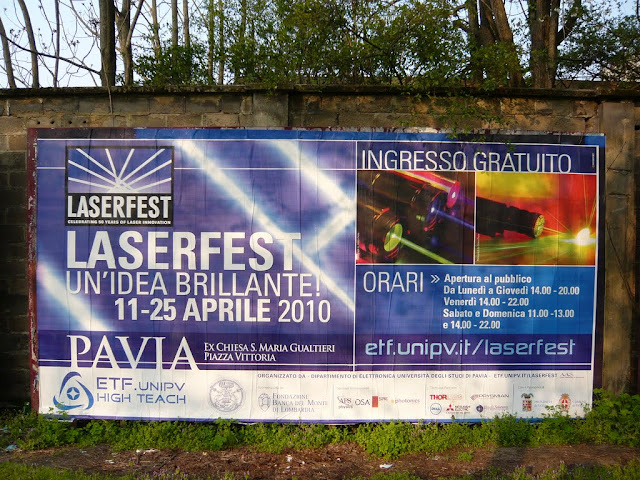
LaserFest- Un'Idea Brillante! -University of Pavia, Italy
The realized exhibit was composed of 12 stands:
1- Video:
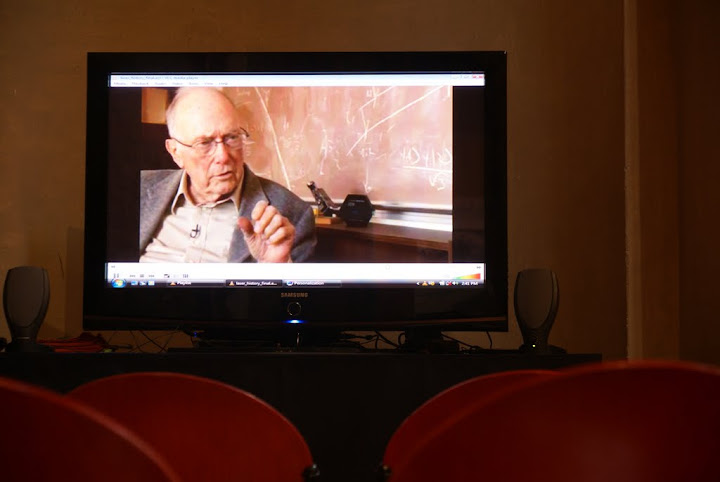
We showed the two videos containing the interview to Charles H. Townes. The videos have been dubbed in Italian, and the dubbed version can be provided on request.
2- Properties of light, and differences between lamps and lasers light.
This stand was dedicated to illustrate the basic properties of light and to discuss phenomena like reflection, refraction, total internal reflection, interference and polarization. The installation included also an “experiments manual”, so that the visitors could also realize them directly.
3- LASER sources:
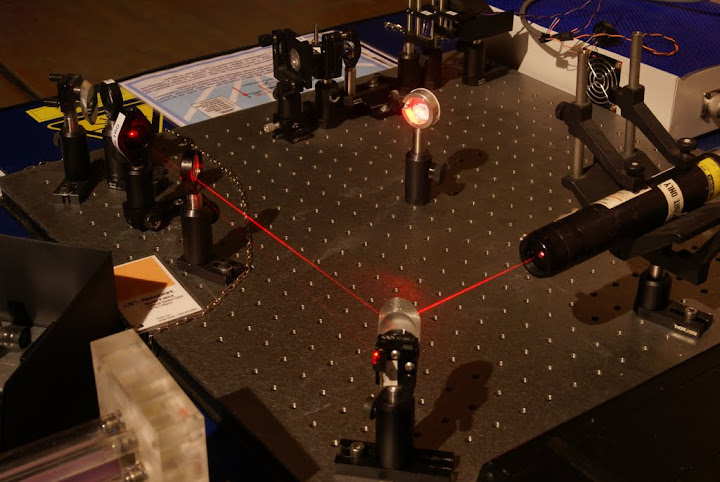
On this stand it was possible to observe several laser sources, based on different active media: diode pumped solid-state lasers (Nd:YVO4), gas lasers (He:Ne), semiconductor lasers, and also a Nd-glass laser. Some of the laser sources could be switched on and operated, and were also used to show how the alignment of mirrors affects the laser mode sustained by the cavity. We also gave to the visitors the possibility to directly modify the LASER cavity, and to observe how it affected the laser beam properties. The Nd-glass laser source was disconnected from the power supply, and was used just to show the different structures of the LASER cavities, and of the pumping system. One of the semiconductor LASERS was put under a microscope, so that all the visitors could see its size and structure.
4- Holography:
This part was dedicated to show two rainbow holograms and to explain how holograms can be realized, viewed and used. The holograms have been made available, for the period of the exhibit, by Prof G. Molesini of INOA (Istituto Nazionale di Ottica Applicata – National Institue for Applied Optics, Pisa, Italy).
5- Nonlinear optics:
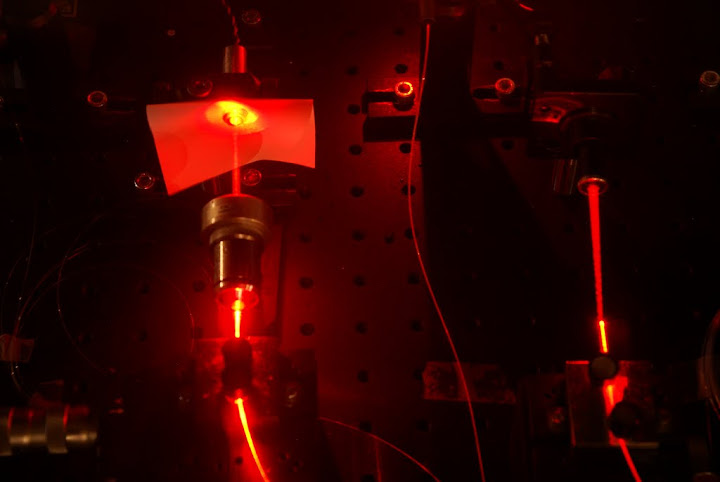
By using a Q-switched Nd:YAG laser source (emitting at 1064 nm) we showed two nonlinear phenomena. The second-harmonic generation (producing green light) and the Raman scattering (yielding to the generation of red light). In particular we also discussed the use of optical nonlinear techniques for different applications.
6- Optical fibers
This stand was divided into three smaller parts. In the first one the Tyndall experiment is recreated, showing the possibility to guide light using water. In the second section the optical fibers are introduced, showing how they are created, their properties and the possible techniques to couple light into an optical fiber. The visitors also had the possibility to modify the different coupling stages, and to observe the differences between single-mode and multi-mode fiber coupling. In the final part of the stand we showed also the instruments used to remove the fiber coating and to cut and splice fibers.
7- Telecommunication systems
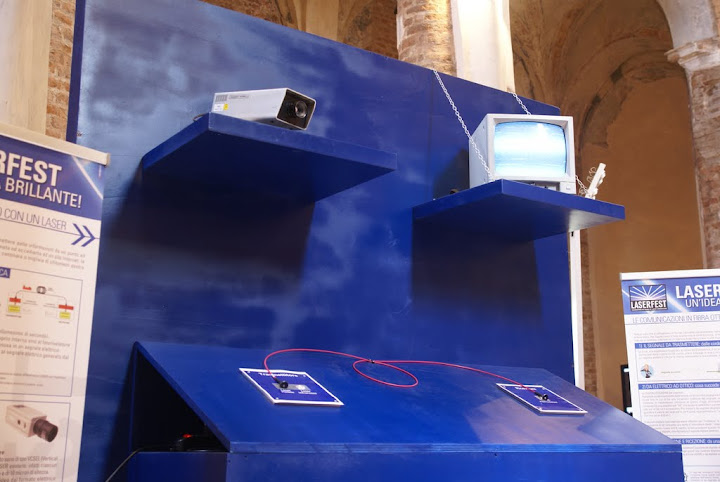
An example of fiber-optic telecommunication system was arranged, including: i) two VCSEL-based laser transmitters (one visible-red, the other infrared); ii) a large-core optical fiber; iii) a photodetector. The signal that was transmitted by intensity modulation was an analog video signal taken from a vidicon camera (a scene from the exhibit), and it was displayed onto a video monitor. The fiber was to be manually aligned by the visitors at both the transmitter and receiver side; when the alignment was OK the monitor displayed the camera image, otherwise the monitor picture was noisy.
8- CD-reader and bar-code reader
This stand was dedicated to show two lasers applications that are widely used during everyday’s life. On one side we realized a schematic CD-reader, showing how the laser light reflected by the CD is detected and converted into a signal. To better illustrate this part we also realized a panel to explain the differences between CD, CD-RW, DVD and Blue-Ray. The bar-code reader was realized using a mirror, mounted on a motorized stage, and a semiconductor laser emitting red light. By opening the case containing the instrument it was possible to observe the turning mirror, the light source and detectors.
9- Distance measurement
Two distance measuring systems were on display. The first one was based on a commercial handheld time-of-flight telemeter, with an accuracy of 1 mm. The telemeter measured the position of a toy train travelling on a railroad track, while the position was graphically represented on the monitor of a PC interfaced to the telemeter. Another sensor, based on the principle of triangulation, was used to measure the profile of the train, which was displayed on the PC monitor alongside with the train position.
10- Vibrations measurement
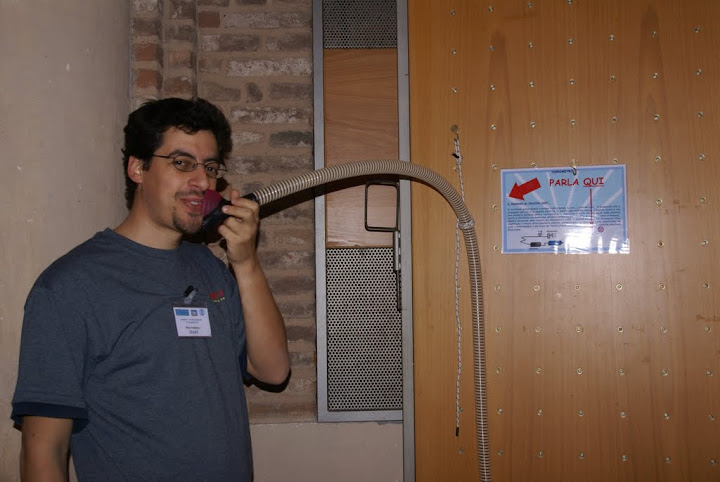
Two special laser vibrometer instruments developed by the University of Pavia were used to demonstrate the capabilities of laser instrumentation to measure very small displacement with high accuracy. The two optical sensor heads of the first instrument were aimed at two small loudspeakers that were driven by audio signals of very low level, such that no sound could be heard from the two loudspeakers. The first laser was aimed at the loudspeaker membrane, and measured its displacement. The electrical signal generated by the instrument was a perfect analog replica of the displacement, and it was electrically amplified and supplied to another large loudspeaker, that reproduced the sound that was intended to be applied to the tiny loudspeaker. The second laser was aimed at the wall of a Plexiglas box that contained the other tiny loudspeaker, thus demonstrating that it can be possible to listen to people talking in a closed room by shining a laser beam on the window of the room. A third experiment used another laser vibrometer to measure the displacement of the rubber membrane placed at one end of a 5 meter long rubber tube. Visitors were invited to speak into the other free end of the tube. The vibration of the membrane was converted into an electrical signal by the laser vibrometer, and then supplied to the electrical power amplifier, and the visitor’s voice reproduced by another large loudspeaker.
11- Biophotonics
Different Biomedical applications of laser light and optical fibers were shown in this stand, including both research level applications and common commercial objects. In particular we had a laser-device for dentistry, a fiber-optic gastroscope, and an optical stretcher. In order to offer the visitors a high interactivity with the gastroscope, we realized a “dummy patient” with tubes and bifurcations, and inserting some small objects at the tube ends. The optical stretcher explanation took advantage of some panels and of a presentation, whose slides were cycling on a screen. The stretcher on display at the exhibit was also used for live demonstrations by experienced researchers.
12- Industrial applications
This stand was realized also thanks to the support we received from Orotig S.r.L. (an Italian company working on LASERS welding) which gave us the possibility to use, and show a laser welder during the exhibition. For safety reasons no visitor has been allowed to use the laser welder, but they could see what was happening inside the system, and they were encouraged to test the strength of the realized weld.
Thank you to the LaserFest-PV team for all your great work!
Hands-On Optics in Guatemala
“Hands-on Optics in Guatemala,” a hands-on, inquiry-based science exploration activity initiated by Dr. David Scherer of PSI, took place in March of 2010 in Guatemala City and Antigua, Guatemala. The project consisted of developing a Spanish-language version of existing Hands-on Optics modules and providing an outreach activity for students and teachers at three schools in Guatemala. The aim of the project was to disseminate an existing optics education curriculum in a Spanish-speaking country in the developing world.
The Hands-on Optics1 modules were originally developed by a grant from the NSF and today operated by a partnership that includes OSA, SPIE, and NOAO. The modules consist of six hands-on, inquiry-based, “laboratory in a shoebox” optics and laser education kits designed for use by middle school and high school students. The “Hands-on Optics in Guatemala” project developed a Spanish-language translation of the instruction manuals for Modules 1 and 6, the two modules that are most related to lasers. These Spanish-language manuals are being provided for use by NSF, OSA, SPIE, NOAO, IEEE, or any other organization or individual for educational, non-commercial use.
Randolph College's ScienceFest: Hands-On Lasers
Submitted by Peter Sheldon
Randolph College was awarded $6200 to buy laser equipment for outreach and for courses. Our biggest event that included Laserfest activities was the Science Festival weekend, where one of the many events was a laser outreach activity during our Science Day (Saturday afternoon activities). We ran about 200 children through laser activities. Science Festival was March 26-28, 2010. More information can be found at the website, http://physics.randolphcollege.edu/sps/sciday. A press release about the Science Festival can be found at http://web.randolphcollege.edu/newsevents/pressreleases/news_detail.asp?id=1202. Some photos of the laser activities and of the Science Festival in general are attached.
There was an article written about the Laserfest grant in our Randolph Magazine that has a wide in print distribution of all current students, faculty, staff, and alums. The electronic version is at http://www.randolphcollege.edu/randolph_magazine_201002_new_lasers.xml.
A second outreach opportunity occurred from June 21-25, when we did a teacher institute on campus to help give teachers resources to better teach hands-on science. See press release http://web.randolphcollege.edu/newsevents/pressreleases/news_detail.asp?id=1128 and website http://tnst.randolphcollege.edu/apply. We did one laser activity with the teachers. For the first time this year, with the help of the Laserfest grant, we were able to do the laser labs properly in physics classes. We did a few simple laser labs in the General Physics II class http://physics.randolphcollege.edu/lab/106_116lab/Laser/index.htm; the one that the extra equipment allowed me to do properly was the measurement of the speed of light (we now have enough equipment for all the lab groups). And we did a basic laser diffraction lab in the advanced laboratory class http://physics.randolphcollege.edu/psheldon/classes/p332/Labs/Laser/Diffraction.htm. These links are to the lab manual.
In the future, we will continue to use the labs in the physics classes at Randolph College, and we will use the lasers in the 2011 Science Festival and beyond.
Randolph College was awarded $6200 to buy laser equipment for outreach and for courses. Our biggest event that included Laserfest activities was the Science Festival weekend, where one of the many events was a laser outreach activity during our Science Day (Saturday afternoon activities). We ran about 200 children through laser activities. Science Festival was March 26-28, 2010. More information can be found at the website, http://physics.randolphcollege.edu/sps/sciday. A press release about the Science Festival can be found at http://web.randolphcollege.edu/newsevents/pressreleases/news_detail.asp?id=1202. Some photos of the laser activities and of the Science Festival in general are attached.
There was an article written about the Laserfest grant in our Randolph Magazine that has a wide in print distribution of all current students, faculty, staff, and alums. The electronic version is at http://www.randolphcollege.edu/randolph_magazine_201002_new_lasers.xml.
A second outreach opportunity occurred from June 21-25, when we did a teacher institute on campus to help give teachers resources to better teach hands-on science. See press release http://web.randolphcollege.edu/newsevents/pressreleases/news_detail.asp?id=1128 and website http://tnst.randolphcollege.edu/apply. We did one laser activity with the teachers. For the first time this year, with the help of the Laserfest grant, we were able to do the laser labs properly in physics classes. We did a few simple laser labs in the General Physics II class http://physics.randolphcollege.edu/lab/106_116lab/Laser/index.htm; the one that the extra equipment allowed me to do properly was the measurement of the speed of light (we now have enough equipment for all the lab groups). And we did a basic laser diffraction lab in the advanced laboratory class http://physics.randolphcollege.edu/psheldon/classes/p332/Labs/Laser/Diffraction.htm. These links are to the lab manual.
In the future, we will continue to use the labs in the physics classes at Randolph College, and we will use the lasers in the 2011 Science Festival and beyond.
University of Iowa: Hawk Eyes on Science
The “Hawk-Eyes on Science” outreach program of the Department of Physics and Astronomy at the University of Iowa has provided outreach venues on a variety of topics for several decades. The Department is also part of the University of Iowa Optical Science and Technology Center http://www.ostc.uiowa.edu/, where nine faculty of the department are members. This gives the Hawk-Eyes on Science access to cutting edge developments in optical and laser physics. With help of a LaserFest grant, all 2010 outreach is laser based through lecture series, demo events, and an interactive laser display.
Browse pictures and video from demo shows here: http://faraday.physics.uiowa.edu/hes/events-2010.htm
LaserFest interactive laser display at the University of Iowa Main Library:
Traveling Outreach Project: Optics on the Road, University of Stellenbosch, South Africa
Optics on the Road Tour: Namibia 2010
Host Organization: University of Stellenbosch/ Stellenbosch Laser Student Chapter
Event Dates: July 3-16, 2010
Event Description: Eight students of the Laser Research Institute at the University of Stellenbosch went on a science education outreach road trip in order to bring laser and optics demonstrations to schools in South Africa and Namibia that are usually out of reach of usual university activities such as Open Days and Science Weeks. Using two vehicles and a trailer, we travelled ca. 5500 km and visited 9 schools along the way - from private schools in Windhoek, the capital of Namibia, to rural schools in Nyangana at the Namibian-Angolan border. We presented an interactive science show at the schools, covering topics such as diffraction and refraction, the mixing of colours demonstrated using lasers, liquid crystals, basic properties and application of lasers, laser communication as well as fluorescence and phosphorescence. We designed our presentation in a modular fashion, enabling us to adapt the show according to the knowledge of the learners in the different schools. In this way, we often did multiple sessions in one school for grades 8 - 12, reaching out to more than 500 children in remote areas, some of which have never seen a laser before. In addition, we hosted a community exhibition in Nyangana, attracting an additional 150 members of the general public. Details of the route and pictures of the trip can be found on www.facebook.com/LaserChapter
Host Organization: University of Stellenbosch/ Stellenbosch Laser Student Chapter
Event Dates: July 3-16, 2010
Event Description: Eight students of the Laser Research Institute at the University of Stellenbosch went on a science education outreach road trip in order to bring laser and optics demonstrations to schools in South Africa and Namibia that are usually out of reach of usual university activities such as Open Days and Science Weeks. Using two vehicles and a trailer, we travelled ca. 5500 km and visited 9 schools along the way - from private schools in Windhoek, the capital of Namibia, to rural schools in Nyangana at the Namibian-Angolan border. We presented an interactive science show at the schools, covering topics such as diffraction and refraction, the mixing of colours demonstrated using lasers, liquid crystals, basic properties and application of lasers, laser communication as well as fluorescence and phosphorescence. We designed our presentation in a modular fashion, enabling us to adapt the show according to the knowledge of the learners in the different schools. In this way, we often did multiple sessions in one school for grades 8 - 12, reaching out to more than 500 children in remote areas, some of which have never seen a laser before. In addition, we hosted a community exhibition in Nyangana, attracting an additional 150 members of the general public. Details of the route and pictures of the trip can be found on www.facebook.com/LaserChapter
Subscribe to:
Posts (Atom)